When we started our adoption journey, we thought we were prepared. We had read the books, completed the classes, and filled out more paperwork than I care to remember. But some of the most important lessons didn’t come from a training binder—they came from living it, one day at a time. If you’re considering adoption, or you’re already in the thick of it, this post is for you. Here are three things I wish someone had told me before we began. I hope they help you feel a little more prepared, and a lot less alone.
If I could go back and tell myself one thing before we started, it would be this: there will be days when you want to quit—and you can’t. Adoption isn’t a single moment; it’s a long road, and some stretches are much harder than anyone warns you about. Children who have experienced loss, instability, or trauma often carry that hurt into their new homes, and it can show up in ways that test every ounce of your patience.
For us, it showed up most in discipline. The approach that worked for our biological children didn’t work the same way for our adopted child. A time-out that meant “I made a bad choice” to one child could mean “I’m not wanted” to another. We had to learn new ways—keeping our child close instead of sending them away, and focusing on connection before correction. Some of it worked. Much of it took far longer than I expected.
“Some days the most important thing I could do was simply not give up—on my child, or on myself.”
That feeling wasn’t new to me. Early in our marriage, every time Mike and I argued, I would wonder if he was thinking about divorce, and that fear made me afraid to communicate fully with him. It took me a long time to realize we were in complete alignment that divorce was not an option. The same thing happened when I began homeschooling our children. I questioned whether I could measure up, and almost every day I felt like giving up and sending them back to “regular” school. I had to remember why we made that decision and treat it like marriage: there was no going back, no divorce.
When we decided to adopt, those same questions came back, only louder. When I didn’t feel the same love for our adopted son as I did for our biological children, I asked myself, “Are we the right parents for him?” When he continued to lie, despite all of our best efforts to change that behavior, I asked again. When he ran away, I asked again. It took me a long time to settle it in my mind and heart that, just like marriage, it is in sickness and in health, for better or for worse: we are his parents. Adopting him was not a mistake, and it is not something I need to take back. He needs to know that we are in alignment that “divorce” is not an option, despite the arguments.
There were days when progress felt like one step forward and two steps back, and nights when I questioned whether I was the right parent for my child. What I didn’t understand at the beginning is that a child who has been let down before is often testing whether you’ll stay. The pushing away, the hard behavior, the rejection—sometimes those are the very ways a hurting child asks, “Are you going to leave too?”
Every time we showed up again—calm, consistent, and still there—we were answering that question. Not giving up didn’t mean never feeling tired or discouraged. It meant leaning on others for support, taking breaks when we needed them, forgiving ourselves for the hard days, and coming back the next morning ready to try again. Slowly, trust began to grow.
He asked me once if I regretted adopting him, and my answer came easily. Is it one of the most terrifying, difficult, and frustrating things I have ever done in my life? Yes. Do I regret it? No. Theodore Roosevelt said, “Far and away the best prize that life has to offer is the chance to work hard at work worth doing.” Raising a child who needs us to stay is exactly that kind of work.
The takeaway: Don’t give up. Healing takes time and progress may be slow, but your consistency tells your child they are safe and they are staying. Keep showing up.
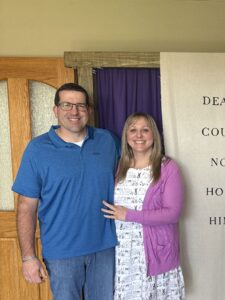
Mike and Allison Hoke, Parents, Adoptive Parents, Authors, Speakers